“Man in his misguidance has powerfully interfered with nature. He has devastated the forests, and thereby even changed the atmospheric conditions and the climate. Some species of plants and animals have become entirely extinct through man, although they were essential in the economy of Nature. Everywhere the purity of the air is affected by smoke and the like, and the rivers are defiled. These and other things are serious encroachments upon Nature, which men nowadays entirely overlook but which are of the greatest importance, and at once show their evil effect not only upon plants but upon animals as well, the latter not having the endurance and power of resistance of man.” 1832
“Motherhood is a proud profession” the wise old bumper sticker
says. Hard to argue with that, except to include both genders. Parenthood is
one of the most critical and yet undervalued endeavors we can undertake
today. Many VHEMT Volunteers and Supporters are parents, having achieved
awareness after making their heirs. And many who haven’t bred are more
lucky than righteous. The past is history. What really matters is the number
of off-spring we don’t create in the future. Complaints of mothers and fathers being disrespected by others who care
about planet Earth aren’t entirely imaginary. A kick-butt mentality
dominates our society: identify the enemy and kick its butt. Because breeding
is the heaviest impact we can have on Nature, some see parents as enemies of
the planet. But, if we all hop around in circles trying to kick each
other’s butts, all we’ll get is pratfalls. We don’t have to
be brain surgeons to figure out that kicking butts isn’t the way to
change minds. Plenty of young people could benefit from some responsible parenting.
Those of us who are so inclined may rightly be proud of accepting the
challenge and responsibility of parenting an existing child. The work of preserving and restoring what’s left of Earth’s
biosphere won’t be finished in our lifetimes, so it’s critical
that we include younger people, giving them the opportunity to carry on the
work. However, creating more of us to carry on is unnecessary and
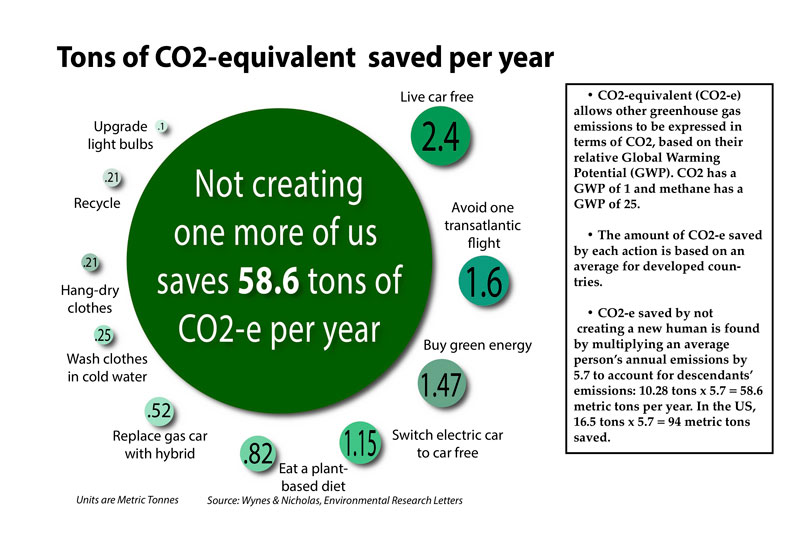
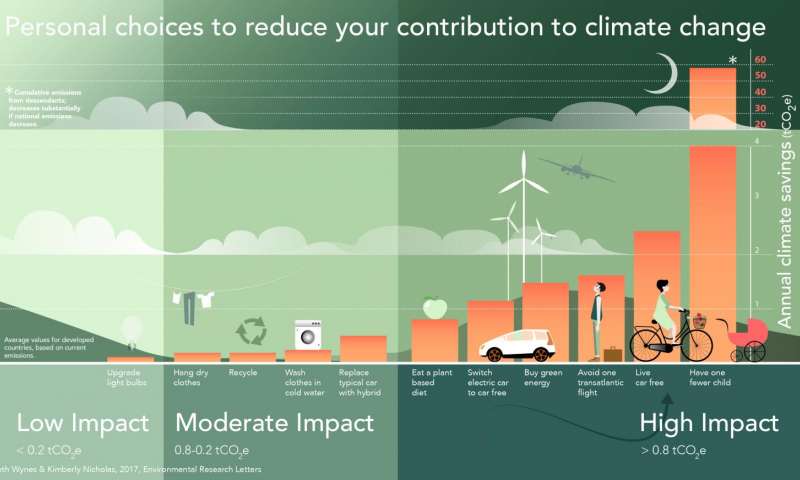
counter-productive. Choosing to refrain from adding another of us greatly reduces our potential greenhouse gas emissions: The outsized bubble for adding another person derives from multiplying an average person’s emissions by 5.7 to account for descendants’ emissions. Other actions measure current emissions, and aren’t spread out over generations. Maybe it would be more fair to use average emissions on the new human without considering their descendants. In the US, that’s 16.5 tons per year, still nearly double all the others combined. The carbon legacy assumes descendants will generate the same amount of emissions in the future, though it could be more or less. In addition to a new human’s personal footprint, providing for offspring naturally requires more resources, increasing parents’ emissions. However, non-parents are likely spend the money they saved in ways that also generate emissions. Some folks say, “Extinction is natural. 99.9% of all species of
plants and animals that have ever existed have gone extinct.” Puts it into perspective, doesn’t it? We shouldn’t get peeved
about a few million extinctions today. It’s all part of the natural
process of life on Earth. By the same reasoning, we shouldn’t care about people dying young.
Most people who have ever lived are already dead, and all of us will die
eventually. It follows that extinction of the human race shouldn’t
raise an eyebrow, either. However, if it’s true that species alive today represent only 0.1%
of Earth’s entire biological history, their extinctions are all the
more tragic. After evolving at the expense of kabillions of other species,
and passing genetic coding on through billions of years, any species alive
today, including our own, deserves profound respect and reverence. In a sense, all living things are at the peak of evolution. Sacrificing
the very existence of any life form for something as superfluous and
transitory as money is an outrageous crime against Nature. Today’s extinction rate is estimated to be between a hundred and one
thousand times the average for the eons, and virtually every species’
demise stems from the activities of one species. Guess who. Our voluntary extinction for the eternal good of all other life on Earth
will be the ultimate demonstration of the best qualities of humanity:
compassion and reason. We certainly have the most power. We have the power to destroy the planet
or to help it return to a natural paradise. Our choices have more impact than
the choices of other animals, so in some ways, Homo sapiens is the most
important species on Earth. Another test of our importance is to ask how well Earth’s biosphere
would get along without us. The higher a species is on the food chain, the
less important it seems to be to the survival of that chain. Biodiversity is being greatly diminished by the extinction of carnivorous
predators, and their prey species are affected adversely, but the chain is
being shortened more than it is being broken. Likewise, humans have virtually
left the food chain and will not create a missing link when going extinct. Microscopic bacteria in the intestines of termites is critical to the
continuity and survival of Earth’s web of life. As special as Homo
sapiens may be, we seem to be an expendable species in this biosphere. Extinction of the couple dozen species which live only on humans is
tragic, but unavoidable. Although our hearts might not go out to the crab
louse, and few of us have ever seen any of the billions of mites and microbes
which live on and in us, each is a unique lifeform contributing to the
diversity of life on Earth. Download Eco Depth Gauge as a pdf. It has been said that our environmental woes stem from being out of touch
with the natural world. Perhaps this check list will help to restore our
sense of place in Nature. Join the search for a human niche, and help
determine where on Earth we fit. Check off as many niches as fit us: Many cling to the quaint notion that we are still a part of Nature, and
perhaps we are, depending on how “a part of” is defined. An established and balanced ecosystem functions in a dynamic symbiosis.
All species interact with each other in three possible ways: mutualistic,
communalistic, or parasitic. A mutualistic relationship helps both organisms.
A communalistic relationship neither helps nor harms the interacting
organisms. A parasitic relationship helps one and harms the other. Are we a part of Nature in the same way a timber company is a part of the
forest? Or the same way a farmer is part of the farm? We could be part of
nature the same way, say, an otter is: eating sea urchins and being eaten by
sharks. We were once like the otter, part of the ecosystem. Then we developed
agriculture, and have become parasitic, depending on exploitation of Nature
for our survival, but giving nothing back. The fossil record shows that each time Homo sapiens entered a continent, a
spasm of extinctions followed. Exotic invaders typically disrupt ecosystems,
and we are no exception. On some philosophical level there is no doubt some truth feeding the myth.
However, by examining our daily lives, and asking ourselves, “What part
of my normal day is a part of Nature?” the sad truth is revealed. It’s true that people are crowded together in some areas while other
areas remain relatively uninhabited, but let’s define inhabited. Just
because we don’t see houses and people doesn’t mean the land is
uninhabited. Farm land and range land is inhabited, as are military bases and bombing
ranges. Second growth forests are actually managed tree farms for human
benefit, many are over-grazed as well. If we define uninhabited as areas
where human influence is ecologically insignificant, we’ll find very
little land left to spread out on. It’s naïve to think that all we have to do is distribute
ourselves better to solve crowding problems. We need far more than a place to
squat. We need water, food, and warmth. And, whether we realize it or not, we
need large wilderness areas, uninhabited by human beings. In terms of environmental impact, crowding humans together in cities
preserves natural areas better than spreading us evenly over the whole land.
This, like all migration-control attempts, provides only a temporary
reprieve. Population centers send out their tentacles to bring in supplies
from rural and natural areas. Consumption has a lot to do with our footprints, and reproduction multiplies
consumption. After determining the size of your footprint, add 50% of it for
each new person you have created. Do not count adopted, foster, or step
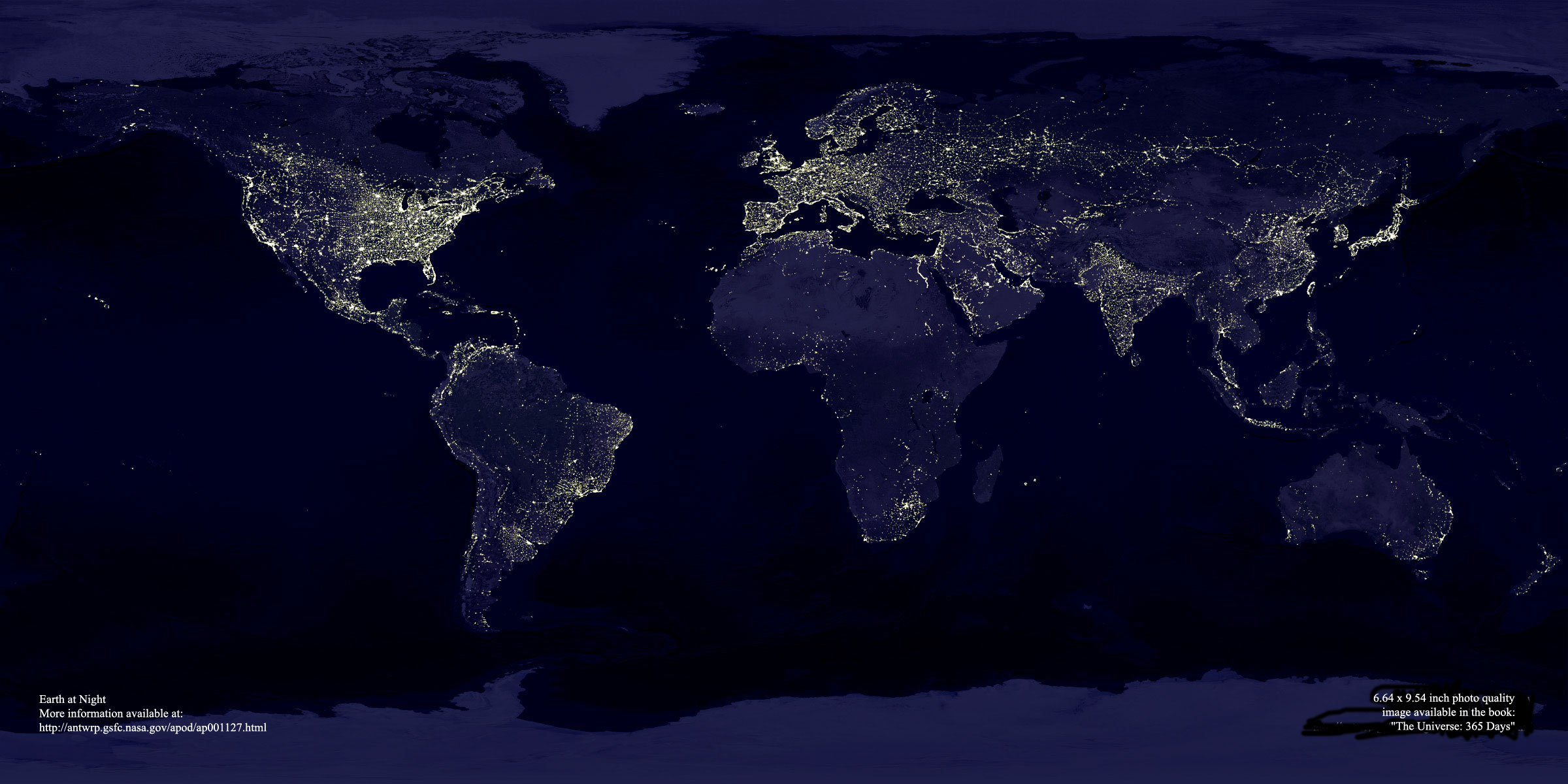
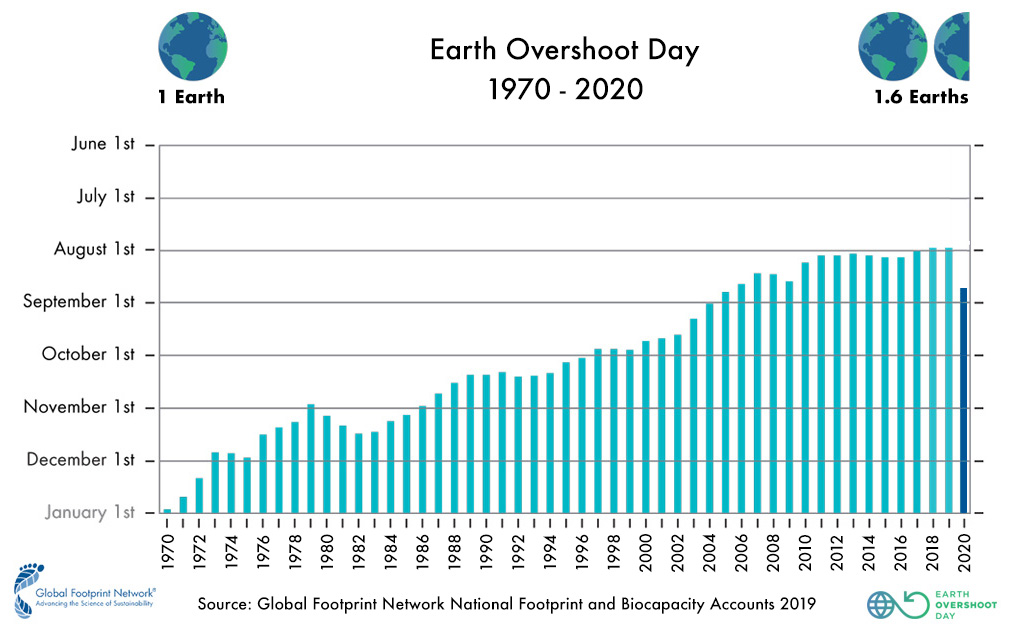
children. Viewing Earth at night reveals the extent of human habitation. (North Koreans turn their lights out at night). National footprints have been calculated by the Global
Footprint Network, which determine whether a nation’s footprint is
smaller than biological capacity—providing an ecological reserve—or is in
overshoot and has an ecological deficit. Earth's carrying capacity for our species was exceeded in the 1970s and our overshoot increases as population and consumption increases. At the same time, carrying capacity is reduced by topsoil loss, desertification, cropland salinization, collapse of fish stocks, depletion of aquifers and other fresh water sources, and so on. In 2010, we used one and a half year's worth of Earth's resources: an estimated overshoot of 60%. Q: Won’t Mother Nature restore a balance if we get too
over-populated? When the Dutch explorer Jacob Roggeveen discovered Rapanui on Easter day
1722, there were about 2,000 people, no trees or bushes over ten feet high.
No bats, birds, lizards, or land snails. They did have chickens, their only
domestic animal. Their boats were so leaky that they had to bail as much as
paddle. It was not always this bad on the island. Pollen analysis of core samples taken back to England for study, and analysis
of kitchen middens, is revealing a drama which is being played out on a
global scale. Just as we can’t leave Earth, they couldn’t leave
Rapanui. Around 400 CE, a few Polynesians landed on a tropical paradise. Within a
century they were constructing the familiar stone statues which Erich Von
Daniken figured must have been carved by visitors from space—the people
sure couldn’t have done it with their lack of materials. For at least 30,000 years before the arrival of this new exotic invader,
Rapanui was a thriving, diverse ecosystem. Huge palm trees were perfect for
canoes, which they used to hunt porpoises. By 800, destruction of the forests
was well underway, and by 1400 the palm was extinct. Human population may
have peaked at 20,000. Imagine the last tree being cut for a canoe and some radical environmentalist
spouting doom and gloom about there being no canoes for future generations.
Porpoise was about one third their diet, and couldn’t be hunted without
the large canoes. Trees may have been used to move the statues from quarries, as
each clan worked to get ahead. It appears that society broke down quickly, with tools in the quarries
abandoned and statues half-finished. The picture is still being filled in,
and debate continues regarding cannibalism. A Rapanui insult from modern
times translates as “Your grandmother’s flesh sticks in my
teeth.” Human sacrifice and inter-island wars kept other pacific island populations
at sustainable levels. Fortunately, modern societies potentially have an
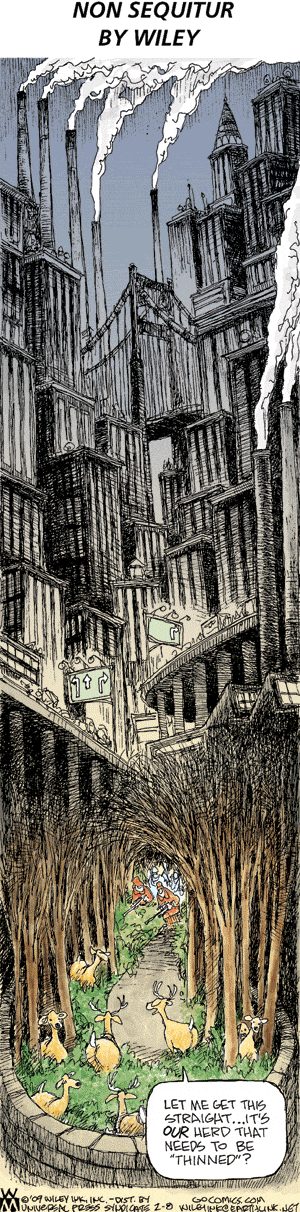
alternative to this death control: birth control. Cartoon of St. Matthew Island's reindeer population overshoot and dieoff. Homo sapiens’ population was reduced to fewer than 10,000 individuals
at some time in our existence, an estimate based on the similarities of our
DNA. This bottleneck likely happened 73,000 years ago when the Toba
volcano rained ash on our habitat and precipitated a volcanic winter. Ten
thousand would certainly be a sustainable number, if we weren’t so
fecund clever. Introduction of one breeding pair of an exotic species is all it takes to
disrupt an ecosystem and cause extinctions of native species. We have evolved
into a virtual exotic invader of Earth’s biosphere as a whole,
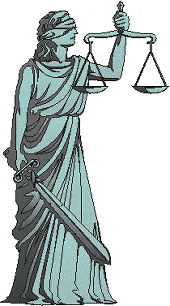
incompatible with undomesticated life forms. If we use a balance scale like blind Justice holds, place all the species
going extinct on one side, and place us on the other—giving us about a
100,000 times more weight because we invented the scales—the sales will
tip in favor of our extinction, even with our weighted advantage. Contrary view of Toba eruption. If Justice uses her sword to mete out vasectomies when the verdict is
revealed, let’s hope she takes off the blindfold. Perhaps by considering our own extinction, we will more fully appreciate what
the extinction of other species means. Big thicket hog-nosed skunks and
rabbit-eared tree rats may be difficult for us to identify with, but then, so
are some people’s in-laws. Q: Won’t another species come along and do the same thing after
we’re gone? It isn’t impossible that another species will come along and do as we
are, just highly unlikely. No species, as far as we know, has ever taken the
evolutionary sidetrack we have. However, the super-predator
theory suggests that evolution occasionally produces predators so efficient that they wipe
out their food supply and naturally go extinct themselves. Their existence is
so short that evidence in the fossil record is weak. A similar scenario offers a possible solution to the Fermi Paradox.
Perhaps evolution selects against our type of intelligence: clever beings wipe
themselves out in a relatively short time. “Let’s put these together and see what happens.” Many species, not just apes, exhibit intelligence on a par with us—though we try to skew the criteria for intelligence to make it seem like
we’re the smartest. None of them seem to be in line to convert the rest
of the world into their habitat as we are doing. We have an opportunity to prove we can behave benignly despite our biological
heritage. We may never be able to stop fighting with each other, exploiting
the natural world, or giving in to other primal urges, but we can stop
breeding and eventually our nature will be history. As super-predators, humans reshape their prey at super-natural speeds
Q: Is parenthood bad for Earth’s
ecology?
Q: What’s the big deal about animals going extinct?
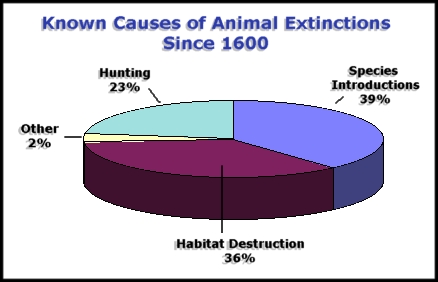
Links to
sites with information about extinctions.
“The Earth does not belong to us, we belong to the Earth. Man did
not weave the web of life, he is merely a strand in it. Whatever he does to
the web, he does to himself.”
Attributed
to “Chief Seattle” (Noah Sealth 1786-1866)
True words, no matter who wrote them.
Q: Are humans the most important species on Earth?
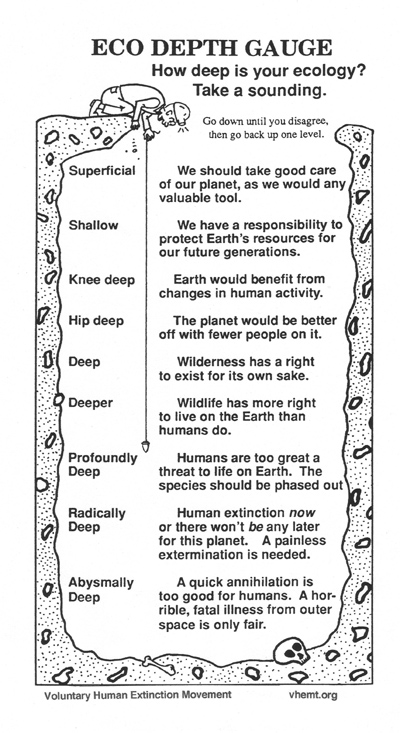

Eco Depth
Gauge by Les U. Knight
is licensed under a Creative Commons
Attribution 3.0 United States License.
Also published in Deep
Environmental Politics: The Role of Radical Environmentalism in Crafting
American Environmental Policy by Phillip F. Cramer, Praeger 1998.
Q: Don’t humans have a place in Nature?
 Q: Isn’t over-population just a human distribution problem?
A more accurate analysis of our impact is what William Rees of British
Columbia, Canada calls our “ecological footprint.” To roughly
calculate your ecological footprint, take this simple quiz.
When our population density improves, we won’t have to convert natural
ecosystems into agriculture, industry, housing, and amusement farms.
A time-lapse taken from the front of the International Space Station as it orbits our planet at night. This movie begins over the Pacific Ocean and continues over North and South America before entering daylight near Antarctica.
“It is a simple logical truth that, short of mass emigration into
space, with rockets taking off at the rate of several million per second,
uncontrolled birth-rates are bound to lead to horribly increased
death-rates. It is hard to believe that this simple truth is not understood
by those leaders who forbid their followers to use effective contraceptive
methods. They express a preference for ‘natural’ methods of
population limitation, and a natural method is exactly what they are going
to get. It is called starvation.”
~Richard Dawkins, The Selfish Gene
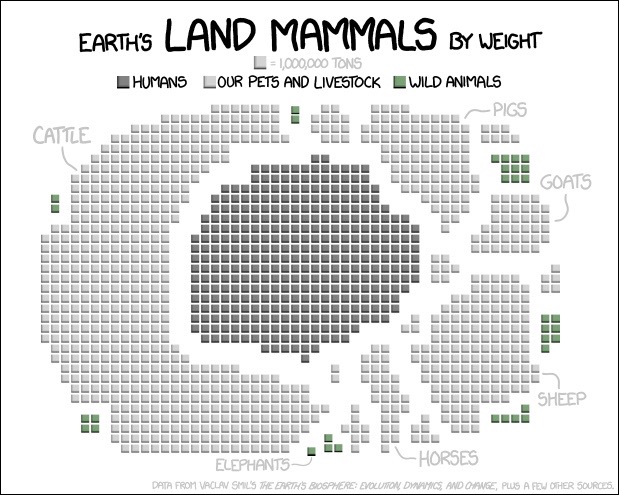
Q: Why extinction? Why not just get our population down to a sustainable
size?
VHEMT Supporters favor this goal, while Volunteers see extinction as the only
sure way to avoid breeding ourselves back to today’s density.
“Darwin’s dice have rolled badly for Earth. It
was a misfortune for the living world in particular, many scientists believe,
that a carnivorous primate and not some more benign form of animal made the
breakthrough.”
E.O. Wilson
Next category: ECONOMICS